
Aisha Shibli
With the rise of Arab students enrolled in post-secondary academic institutions in Canada,[1] concerns over ethnic and racial discrimination continue to be a pertinent subject. The purpose of this brief is to provide policy recommendations to University administrators to address the campus needs of minority students across Canada, particularly Canadians of Arab descent. Recommendations include implementing coherent equity and anti-discrimination policies and procedures; developing compulsory educational workshops for faculty, staff and students; and race-based data collection, all of which will enable Canadian post-secondary institutions to acknowledge and act upon the ongoing discrimination and racism Arab youth continue to face.
[1] Canadian Arab Institute “Number of Arab Students in Canada Spikes,” Canadian Arab Institute, 2013 https://dev.canadianarabinstitute.org/publications/reports/number-arab-students-canada-spikes/ (accessed August 2018).
KEY FINDINGS
- Racism and discrimination are inherently embedded in Canadian university cultures.
- One-third of Arab respondents have experienced discrimination or unfair treatment in Canada due to their Arab identity.
- Canadian universities do not collect race-based data; 63 out of the 76 universities from across the country are unable to provide a breakdown of their student populations due to absence of data collection, despite having diversity offices.
- Equity policies in Canadian universities have a limited effect in adequately addressing discrimination and racism.
- Many Canadian universities are not meeting their legal obligation of having an anti-discrimination policy.
INTRODUCTION
With demographics continuously changing, academic institutions are often held responsible for socializing a youth’s skills, values, and the ability to think critically.[2] Similarly, academic institutions shape the culture of the campus society, and unfortunately, such institutional cultures often lacks a deep commitment to the needs of student minorities. Institutional culture influences the values and beliefs of all students, staff and faculty, however, the culture is largely dependent on the institution’s policies and procedures, yet while this is often reflected in the organizations values, it is not reflected in its practice. Racial and discriminatory practices are embedded in education. Minority students, particularly those of Arab descent, experience high rates of discrimination within their academic institution. Although Canadians of Arab origin are twice as likely to have a post-secondary degree than their Canadian counterparts, results from a national survey of 265 Arab respondents revealed that one-third of the respondents not only experienced discrimination or unfair treatment due to their ethnic, racial, religious, or social differences, they were also subjected to various stereotypes within their Canadian post-secondary institutions. Yet, with sixty percent of Arab youth in Canada holding academic degrees, this feeling of isolation will likely increase. There are many barriers that shape an academic institution’s culture and the importance of racial diversity in education is often overlooked. While many academic institutions overlook minority students’ needs, administrators must recognize and understand that minority cultures exist on their campuses.[3]
Although Canadians of Arab origin are twice as likely to have a post-secondary degree than their Canadian counterparts, results from a national survey of 265 Arab respondents revealed that one-third of the respondents not only experienced discrimination or unfair treatment due to their ethnic, racial, religious, or social differences, they were also subjected to various stereotypes within their Canadian post-secondary institutions.
In 2016, 973 Arab youth from ages 18 to 25 across Canada were surveyed, including those over 30 years old. This policy brief will examine both quantitative and qualitative data. For the purposes of analyzing the various effects of why Arab youth feel discrimination and racism within their universities, the University of Ottawa, Université Laval, Concordia University, the University of Calgary, and Carleton University will be examined, as the majority of the Arab youth surveyed are attending, or have attended, these universities. Due to the selection of the five universities, while not entirely representative of all of the Arab youth respondents, the sample size of respondents is reduced from the initial 973 to 265. The qualitative data is the literature review on campus culture and the five university case studies, which will enable readers to understand how and why discrimination and racism continue to be prevalent in Canadian universities. This research highlights the discriminatory and racist practices as critical variables shaping Arab youths’ experiences on their campuses.
[2] Lisa Tsui, “Effects of Campus Culture on Students’ Critical Thinking” The Review of Higher Education, 23, no.4 (2000):421
[3] George Kuh, “Assessing Student Culture,” New Directions For Institutional Research, no.68 (1990):57.
A Brief Analysis of Discrimination in Canadian Academic Institutions
While Canadian universities have seen an increase in diverse student populations, minorities, particularly those of Arab descent, continue to be underrepresented in many major institutions. Existing research on a national four-year study examines discrimination at Canadian universities found that, to date, post-secondary institutions and other major scholarly bodies have given priority or undertaken research on the lived experiences of minority students in post-secondary institutions.[4] Yet most Canadian universities, although perceived to be inclusive, are often characterized by inequality, indifference and rely on “outmoded conservative traditions”.[5] While overt campus discrimination was not a major issue amongst the respondents, the data nevertheless suggests that institutional racism is still prevalent, even amongst Canada’s largest universities.
While Canadian universities have seen an increase in diverse student populations, minorities, particularly those of Arab descent, continue to be underrepresented in many major institutions
Statistics Canada, and many Canadian universities, does not collect data on minorities in schools, nor do provincial governments. Thus, data does not currently exist on minority students’ experiences on campus, or the effectiveness of university race and discrimination-based policies or procedures. Race-based data is essential to addressing inequality, barriers, and tackling discrimination on campus.[6] I In many universities across Canada, demographics on ethnic students are retrieved from an American undergraduate survey called the National Survey of Student Engagement (NSSE) and often, minority student groups are groups that run under the university’s student union.[7]
In a study conducted by Canada’s Broadcasting Company (CBC), 63 out of the 76 universities from across the country were unable to provide a breakdown of their student populations due to absence of data collection despite having diversity offices.[8] The five Canadian universities on which this brief focuses on do not have disaggregated data on students of colour:
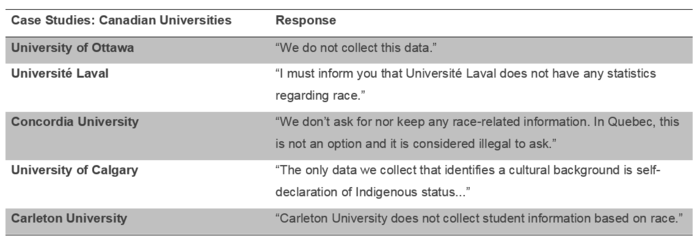
This data was obtained from CBC (McDonald & Ward, 2017).
All five universities do not collect race-based data. Those in support of this data collection view this as an institutional failure and as a severe lack of commitment to minority students. Although it is not illegal for the province of Québec to collect race-based data, the “province's privacy watchdog says universities should be prepared to explain why they need the information if someone files a complaint”.[9] Race-based data is essential to monitoring discrimination and examining the continued systemic barriers that students may face within their institution. Henry and Tator (p.502) argue that “systemic racism in the academy impede[s] social justice, inclusion and equity” which is often a “normative aspect of Canadian ways of doing things, and deeply entrenched within university culture” with under-representation of racialized faculty and leadership and Eurocentric curricula, amongst many other things.[10] . The lack of data indicates that not only are Canadian institutions aware that they are failing to meet their requirements, but that progress towards equality and serving all students’ needs is unlikely in the near future.
[4] Frances Henry, et al, “Race, racialization and Indigeneity in Canadian universities,” Race, Ethnicity and Education, 20, no.3 (2016):1.
[5] Henry, et al, “Race, racialization and Indigeneity in Canadian universities,” 1.
[6] McDonald, Jeremy & Ward, Lori, “Why so many Canadian universities know so little about their own racial diversity,” CBC, March 21, 2017 https://www.cbc.ca/news/canada/race-canadian-universities-1.4030537 (accessed July 2018).
[7] D’Sa, Premila, “University Asks Black Student to Prove Minorities Exist on Campus,” Vice News, November 22, 2017 https://www.vice.com/en_ca/article/pa3nb7/university-asks-black-student-to-prove-minorities-exist-on-campus (accessed July 2018).
[8] McDonald, Jeremy & Ward, Lori, “Why so many Canadian universities know so little about their own racial diversity,” March 21, 2017
[9] McDonald, Jeremy & Ward, Lori, “Why so many Canadian universities know so little about their own racial diversity,” CBC, March 21, 2017
[10] Frances Henry and Carol Tator, Racism in the Canadian University: Demanding Social Justice, Inclusion, and Equity (Toronto: University of Toronto Press, Scholarly Publishing Division, 2009) 69.
Data Analysis
Data from the survey questionnaire suggests 738 of the 973 Arab youth respondents are attending, or have attended, a post-secondary institution. However, for the purposes of the selected five university case studies, the data has been narrowed down to 265 respondents from the University of Ottawa, Universite Laval, Concordia University, the University of Calgary, and Carleton University:
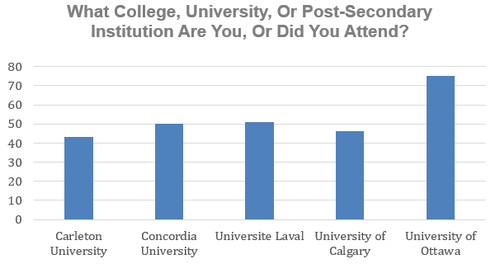
The data collected shows that the University of Ottawa has the highest number of Arab youth attending, with 75 respondents, whereas Carleton University has the least amount of Arab youth, with 43. The University of Calgary trails behind with 46 respondents, with Concordia University and Université Laval with 46 and 51, respectively.
At present, all five universities have equity and affirmative action policies in place, which attempt to create a diverse campus environment by tackling many systemic barriers that staff, faculty, and students face. However, students continue to experience discrimination on campus.
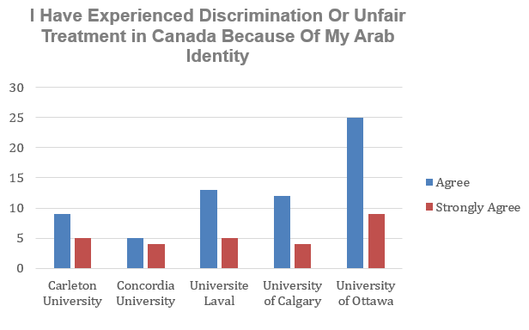
45% of Arab respondents from the University of Ottawa agreed and strongly agreed that they have experienced discrimination or unfair treatment in Canada due to their Arab identity. The remaining universities are as follows: 35% from Université Laval; 35% from the University of Calgary; 33% from Carleton University; and 18% from Concordia University. Of the same universities, 33% of respondents from both Université Laval and Carleton University have faced racial discrimination with a professor or teacher. Respondents from various Canadian universities described their experience with discrimination on campus:
My professor at the University of Ottawa was known to be hateful towards Arabs and Muslims.
A professor failed me for no reason. She passed my partner who did the same work as me (we had a project together).
With a professor who refused to give me the chance to re-do a test while he allowed another Canadian student.
One of my profs one time refused to see me and I thought he was busy, my other friend, Eric, is Canadian and he felt that prof was racist and he went to see him and after 2 minutes the prof did not tell him that he was busy…
With a professor: after submitting an assignment, the professor accused me of plagiarism while I only followed his instructions in class. The professor didn't sanction me but did not apologize either.
Despite one third of the respondents from the selected universities having experienced discrimination in various forms on campus, the majority of respondents from each university believe that their post-secondary institution’s policies are not discriminatory and that their institution’s protocols for addressing incidents of racism are effective. In fact, the data suggests that the respondents believe their institution and campus cultures are open and inclusive, however, a smaller percentage believe this not to be true. Respondents shared past experiences regarding their university’s discriminatory behaviour towards minorities on campus:
The university admin are usually careless when it comes to discrimination. In 2015, the student federation hosted a referendum for students to pay $0.50 towards a racialized student center, and it was not successful.
People in university are very inclusive and nice. The issue is when actual racism takes place, the university does not follow through on complaints by students.
Took us 4 years to get approval from the university to open a club supporting Palestinian students and people and issues.
Minorities, such as the Arab youth, continue to face some form of discrimination, and this may be due to the inherent racism that is embedded in university culture.
It is evident that discrimination and racialization of minorities are not adequately addressed on campus. Minorities, such as the Arab youth, continue to face some form of discrimination, and this may be due to the inherent racism that is embedded in university culture. While anti-discriminatory policies exist at these five selected universities, many modern neoliberal academic institutions continue to rely on outdated conservative traditions. Despite academic institutions’ demographics becoming increasingly diverse, universities do not adequately reflect upon these demographic shifts, particularly with the hiring of faculty members, services for minority students, and workshops for non-racialized staff or faculty members regarding equity, amongst others. Abawi (p.85) claims that the discourse in post-secondary institutions functions “through the lens of the corporatization”[11] where “diversity is commodified as a marketing strategy” to entice minority or international student demographics. Abawi (p.85, 2018) further contends that while half of Canadian university student populations are racialized in subtle forms, racism in Canadian universities operates through various decisions concerning “equity, inclusion, and diversity policies, as well as the university’s campus culture.” Yet, this growing demographic is not reflected in its staff or faculty makeup. One respondent said: “Minorities are definitely underrepresented in the faculty staff” which often makes it difficult for racialized students to feel comfortable on campus. In fact, 81% of the Canadian professoriate demographic is white.[12]
[11] Corporation of the university is a phenomenon that began in the 1980s, where Canadian universities are governed by a hidden corporatization agenda, which ultimately pose a threat to the university’s public mandate (Newson, Polster, & Woodhouse, p. 51, 2012). This form of academic capitalism is recognized as model by which the university’s public funding has been reduced in exchange for a corporate university model (Abawi, p.86, 2018). This model ultimately generates money from its clients (the students).
[12] Zuhra Awabi, “Factors and Processes of Racialization in the Canadian Academe,” Canadian Journal for New Scholars in Education, (2018): 88.
Diversity Initiatives: Case Studies
The University of Ottawa, the University of Calgary, Université Laval, Carleton University, and Concordia University all have an equity office, or equivalent, in place. For the purposes of this brief, below is a brief summary of only a few initiatives each university, and their students’ unions or associations, have in place to address racism, discrimination, and harassment on campus:
The University of Ottawa
The Student Federation of the University of Ottawa (SFUO) currently has a Racialized and Indigenous Student Experience Centre (RISE) for minority students due to a lack of representation on campus. Currently, the SFUO has over a dozen clubs representing minority students. SFUO had an “In My Skin” campaign, which advocated for anti-racism on campus; however, this campaign was met with controversy as students argued that it was a form of segregation where participants were split into separate rooms based on the colour of their skin.[13]
The University of Ottawa has a Diversity and Inclusion Office, Office of Equity, and a Diversity Committee, amongst other initiatives.
The University of Calgary
The University of Calgary’s Students Union allows students to develop cultural or ethnic clubs on campus that represent minority students. To date, there are over 31 clubs that represents these students. Like most student unions, Calgary’s Students Union provides funding to the clubs and allows clubs to host events that support their mandates of inclusivity.
The University of Calgary has implemented an initiative called “Diversity Days” to celebrate minorities in diversity through an art showcase, and there are a number of committees and subcommittees representing minority students on campus, such as the Diversity, Equity, and Protected Disclosure committee.
To date, the University of Calgary does not have an anti-discrimination policy.
Carleton University
The Carleton University Students’ Association has many clubs that represent minority students. The Association also has the International Students Centre, Mawandoseg Centre for Indigenous students, a Multi-Faith Centre, and a Race, Ethnicity, and Cultural Hall aimed to create a safe space for these students on campus.
Carleton University has a Department of Equity Services, and Equity Advisor where formal complaints can be made, and an interfaith calendar, which provides a list of religious observances where students, staff or faculty may be excused for missing a compulsory academic event, amongst other initiatives.
Concordia University
Concordia’s Student Union has led a campaign against racial discrimination and has had a long history of mobilizing against discrimination and racism, but they currently do not have an equity policy in place.
Concordia University has an Office of Rights and Responsibilities, Department of Human Resources, Advisory Committee on Equity and Diversity, Center for Research-Action on Race Relations, and a Code of Rights and Responsibilities, amongst other offices.
Université Laval
In an email exchange, when asked if the Laval has a racialized student service or equity policy in place, a Université Laval’s Assistant to the Vice-Rector, Academic and Student Affairs said: “We do not have such a service…”
63% of the 265 respondents from all five universities agree, and strongly agree, that their post-secondary institution’s policies are not discriminatory, while only 10% believe the policies are discriminatory. The majority of those who believe that their institution’s policies are discriminatory are attending, or have attended, the University of Ottawa, whereas the majority of those who believe that their institution’s policies are non-discriminatory come from the University of Calgary.
Data further suggests that 46.4% of those surveyed from the five universities agree, and strongly agree, that their post-secondary institutions protocols for addressing incidents of racism are effective, whereas 12% disagree, and strongly disagree, addressing incidents of racism as ineffective.
While the University of Ottawa, Université Laval, University of Calgary, Carleton University, and Concordia University have equity offices and some form of employment equity or anti-harassment policies, these policies have a limited effect in addressing racism.
While the University of Ottawa, Université Laval, University of Calgary, Carleton University, and Concordia University have equity offices and some form of employment equity or anti-harassment policies, these policies have a limited effect in addressing racism. In fact, the University of Ottawa and Calgary have failed to meet its diversity targets for hiring visible minorities.[14] Yet, no penalty is in place for schools that fail to meet their equity goals.[15] To understand why 10% of respondents believe that their institution’s policies are discriminatory and 12% believe that their institution’s mechanisms for racism are not effective, one must recognize that there continues to be a lack of sufficient progress in equity matters; in fact, if universities enact cutbacks in funding, equity offices may be the first ones to go.[16]
Minority students on Canadian campuses continue to feel marginalized despite official university equity policies and documents that may contain equity clauses.[17] The explanation may be due to these policies being created by the “white patriarchal culture of academia,” which continue to be formulated by the definitions of racism and equity that are “created by white normative accounts of such issues”.[18] Henry et.al (p.208) states that these policies “exist without the force of concrete action to achieve their goals, and there is no systemic study of the effectiveness of equity policies in Canadian universities.” Such policies often challenge the university’s traditions of academic freedom.[19] While many universities look to the Canadian Human Rights Code when drafting their own anti-discrimination policies, they fail to understand that the human rights model has a series of limitations, including ineffective procedures to implement or address anti-discrimination and harassment policies.[20] A university’s equity and diversity policies largely benefit white women and other equity-seeking groups.[21] Forms of racialization are systemic in that they are built in the very foundation of institutional practices.[22]
[13] Lytvynenko, Jane, “Ottawa Students Tried to Segregate Whites from Non-Whites,” Macleans, March 3, 2014 https://www.macleans.ca/education/uniandcollege/ottawa-students-tried-to-segregate-whites-from-non-whites/ (accessed August 2018).
[14] Hannay, Chris, “Canadian Universities Fail to meet Diversity Hiring Targets,” The Globe and Mail. May 16, 2018 https://www.theglobeandmail.com/news/politics/canadian-universities-fail-to-meet-diversity-hiring-targets/article29935311/ (accessed August 2018).
[15] Hannay, “Canadian Universities Fail to meet Diversity Hiring Targets”, 2018
[16] Eisenkraft, Harriet, “Racism in the Academy,” University Affairs, October 12, 2010 https://www.universityaffairs.ca/features/feature-article/racism-in-the-academy/ (accessed July 2018).
[17] Henry and Tator, Racism in the Canadian University: Demanding Social Justice, Inclusion, and Equity, 72.
[18] Awabi, “Factors and Processes of Racialization in the Canadian Academe,” 90.
[19] Henry, et al, “Race, racialization and Indigeneity in Canadian universities,” 209.
[20] Henry, et al, “Race, racialization and Indigeneity in Canadian universities,” 209.
[21] Awabi, “Factors and Processes of Racialization in the Canadian Academe,” 90.
[22] Henry and Tator, Racism in the Canadian University: Demanding Social Justice, Inclusion, and Equity, 73.
Policy Implications and Recommendations
The table below reveals which institutional authority is responsible for handling formal equity complaints:
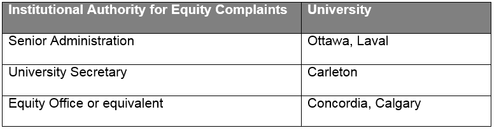
This information was publicly available on the institutions’ website.
Recommendation 1: Policies & Procedures
All five universities have some form of equity and anti-discrimination policy in place. To date, 37 universities in Canada have some form of anti-racist and anti-discrimination policies, however their procedures limit the effectiveness of their policies.[23] Current anti-discrimination or anti-racist policies in Canadian institutions are generally created by the “white patriarchal culture of academia”, and are created by white academics.[24] These policies fail to discuss systemic institutional racism, and it is often deemed as ‘antithetical’ to the purpose of the university.[25]
Many Canadian universities have equity offices and many lack the appropriate mechanisms for developing, implementing, and monitoring complaints.
Many Canadian universities have a process in place to address formal complaints, however, their procedures for complaints vary according to the constituency.[26] Henry et.al (p.210) argues that institutional authorities that implement formal anti-discrimination procedures lack the necessary training in Canadian anti-discrimination and anti-harassment laws. There is a clear limitation of procedures in Canadian universities, as many hired human rights or equity experts in the university lack sufficient training in directly handling investigations or making decisions. Many of these equity experts rely on mediation or intervention to avoid formal mechanisms; in fact, these informal resolutions have proven to be unsuccessful.[27] Many Canadian universities have equity offices and many lack the appropriate mechanisms for developing, implementing, and monitoring complaints. Henry et.al (p.215) notes that racism-based complaints have a higher rate of dismissal, and this may due to universities not meeting their legal obligation of having an anti-discrimination policy.
A few recommendations to overcome this issue include:
- Canadian universities must recognize that their current equity or anti-discrimination policies do not always work; as such, developing and implementing procedures to overcome systemic racism is imperative
- - According their legal requirement as employers, Canadian universities must have policies and procedures (and formal mechanisms) in place to address discrimination and racism
- - Post-secondary institutions must define the discriminatory and racist violations, as lack of definitions can create different standards in assessing and handling complaints
- - Post-secondary institutions must draft and implement equity policies that must be reflective of the lived experiences of minority students
Recommendation 2: Educational Workshops
Due to Eurocentric curriculum and racial microaggressions (in the forms of microassaults, microinsults, and microinvalidations)[28] feelings of alienation and exclusion are not uncommon. While the data suggests that one-third of Arab youth have experienced discrimination on campus, subtle or unintentional forms of racial discrimination continue to exist. Many racialized students, including Arab students, routinely experience invalidations, insults, and assaults on campus. As such, Canadian universities must dedicate their resources to creating the appropriate conditions to support minority students and facilitate a positive campus culture by addressing these racial microaggressions. While many Canadian universities provide discrimination or harassment workshops for staff, faculty and students, these workshops tend to ignore the subject concerning systemic racism; instead, these workshops heavily focus on the university’s policies on these matters.[29]
While many Canadian universities provide discrimination or harassment workshops for staff, faculty and students, these workshops tend to ignore the subject concerning systemic racism; instead, these workshops heavily focus on the university’s policies on these matters.
A few recommendations to overcome this issue include:
Workshops are imperative, particularly when the university lacks the appropriate procedures to handle discrimination violations; thus, monitoring of these programs is essential.
Recommendation 3: Data Collection
Equity and diversity barriers continue to exist for racialized students due to the lack of race-based data collection amongst Canadian universities
Equity and diversity barriers continue to exist for racialized students due to the lack of race-based data collection amongst Canadian universities, as many Canadian universities, including the University of Ottawa, Universite Laval, Carleton University, University of Calgary, and Concordia University, have no data on how their students identify ethnically or racially. This may be due to universities feeling uncomfortable discussing race and concerns over the data being used to target students. Many racialized students, including Arab youth, are dealing with multiple challenges that have negative implications on their overall academic performance.[30] Under the 1986 Employment Equity Act, along with the Federal Contractors Act, Canadian universities are obligated to collect workforce data and analysis, short term and numerical goals, and an equity program to ensure employment equity.[31] However, many Canadian universities do not collect race-based data nor do they release such data to the public if acquired.
A few recommendations to overcome this issue include:
- Data informs policies, programs, and services, thus Canadian universities must collect ethnicity, race-based, gender, and other demographic data to better serve the racialized student population;
- - Collected data requires consistency to monitor the impact of policies on racialized students and developing new programs, thus the data collected must be subjected to strong privacy protections.
Respondents also shared various recommendations for Canadian campuses to improve life on campus for Arab youth, and other minorities:
- - Hire racialized faculty beyond an institution’s tokenistic presence
- - Include non-Eurocentric curricula
- - Create more diverse associations, such as clubs
- - Increase the number of scholarships for minorities, particularly Arabs
- - Promotion of free and open discussions for Arab youth
- - Acknowledge and respect religious or cultural holidays, without punishment
There continues to exist an inherent and indirect culture of racism, discrimination, and marginalization of racialized students in Canadian universities. Race continues to remain a disadvantage for Arab youth attending post-secondary institutions, and by virtue, despite numerous anti-racist or anti-discriminatory policies, it is evident these policies lack a coherent procedure to identify and address ongoing discrimination. Further, the ongoing lack of educational workshops, data, and the lack of diverse curricular, and the hiring of racialized faculty, amongst others, continue to reaffirm that Canadian institutions certainly create barriers for racialized students.
[23] Henry, et al, “Race, racialization and Indigeneity in Canadian universities,” 210.
[24] Awabi, “Factors and Processes of Racialization in the Canadian Academe,” 90.
[25] Awabi, “Factors and Processes of Racialization in the Canadian Academe,” 90.
[26] Henry, et al, “Race, racialization and Indigeneity in Canadian universities,” 210.
[27] Henry, et al, “Race, racialization and Indigeneity in Canadian universities,” 214.
[28] Sarah Houshman, Lisa Spanierman, and Romin Tafarodi, “Excluded and Avoided: Racial Microaggressions Targeting Asian International Students in Canada,” Cultural Diversity and Ethnic Minority Psychology, 20, no.3 (2014): 378.
[29] Henry, et al, “Race, racialization and Indigeneity in Canadian universities,” 210.
[30] Haneen Al-Hassoun, “Most Universities Don’t Collect Data on Student Race,” The Charlatan, March 30, 2017 https://charlatan.ca/2017/03/most-universities-dont-collect-data-on-student-race-including-carleton/ (accessed August 2018).
[31] Awabi, “Factors and Processes of Racialization in the Canadian Academe,” 88.
ABOUT THE AUTHOR