
By Ghina Dajani, CAI Research Fellow
Published: September 2014
The fourth in a series analyzing the 2011 census data released by Statistics Canada, this report shows the levels and fields of education among Canadian Arabs, their employment and unemployment rates, and their fields of employment.[i]
Education is a highly valued commodity within Canadian Arab cultures and communities. This value is reflected in the degree to which Canadian Arabs invest time, money, and effort into pursuing higher education.
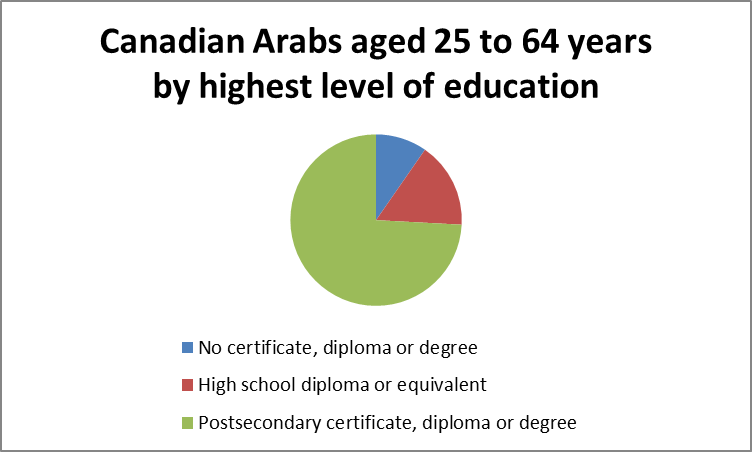
Figure 1
The 2011 census data show that within the Canadian Arab community, the vast majority, 74%, of the population aged 25 to 64 years has completed postsecondary education. This number compares with 64% among the Canadian general population.
Table 1
|
Highest Level of Education Achieved |
||
|
Canadian Population |
Canadian Arab Community |
|
|
No certificate, diploma or degree |
13% |
10% |
|
High school diploma or equivalent |
23% |
16% |
|
Postsecondary certificate, diploma or degree |
64% |
74% |
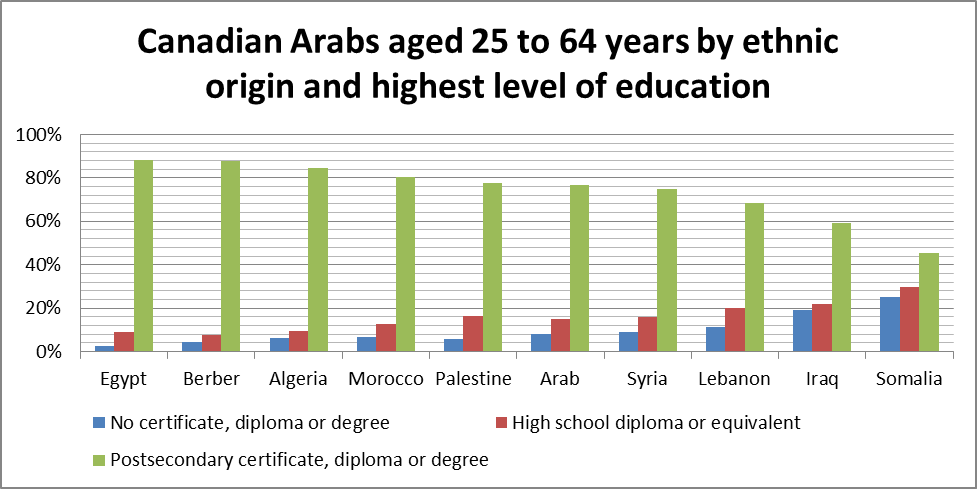
Figure 2[ii]
Within the Canadian Arab community, Egyptians hold the highest level of education, while Somalis hold the lowest. The Somali levels are likely explained by the high percentage of Somali immigrants who came to Canada as refugees, versus those who obtained their residency in Canada through the Skilled Worker program (which requires that applicants have a high level of education).
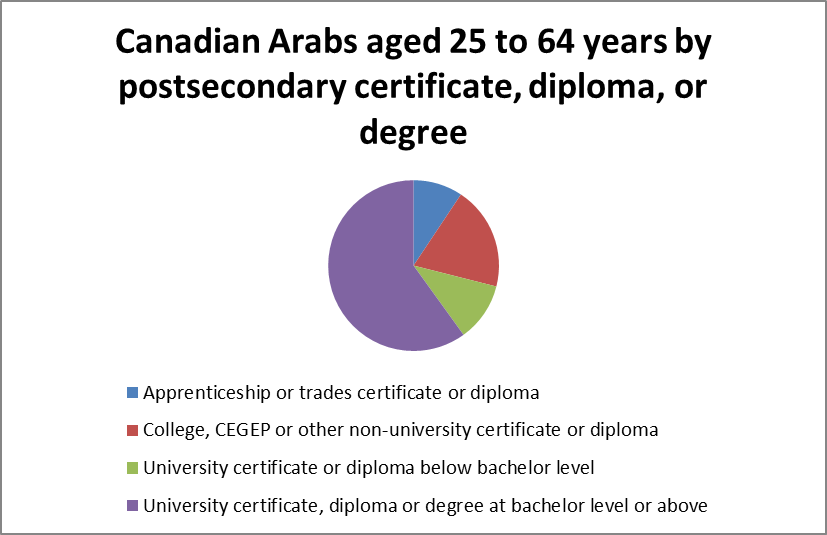
Figure 3
Canadian Arabs are more likely than other Canadians to have completed university education when pursuing postsecondary education. Sixty percent of Canadian Arabs hold university certificates, diplomas, or degrees at bachelor level or above in comparison to 40% of the general Canadian population.
Table 2
|
Highest Level of Postsecondary Education Achieved |
||
|
Canadian Population |
Canadian Arab Community |
|
|
Apprenticeship or trades certificate or diploma |
19% |
9% |
|
College, CEGEP or other non-university certificate or diploma |
33% |
20% |
|
University certificate or diploma below bachelor level |
8% |
11% |
|
University certificate, diploma or degree at bachelor level or above |
40% |
60% |
Furthermore, Canadian Arabs pursuing postsecondary education are more likely than Canadians to choose university education as opposed to apprenticeship, college or other non-university certificates or diplomas. This further reflects the value placed on higher education within Canadian Arab communities, but also speaks to the large numbers of skilled-worker immigrants who came to Canada from Arab countries.
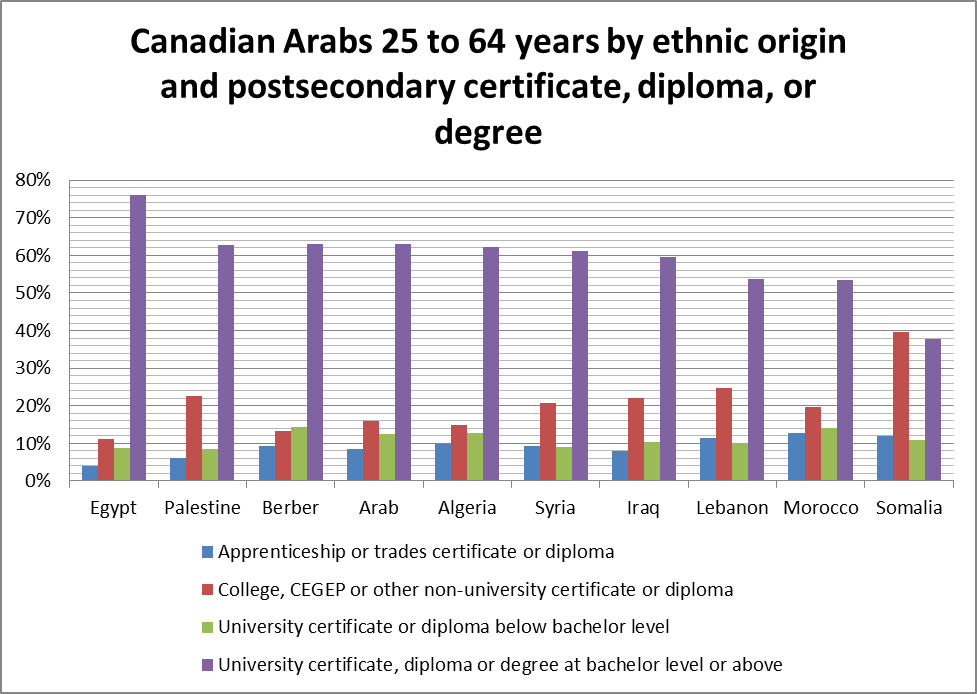
Figure 4
When it comes to the types of postsecondary education present within the Canadian Arab community, the Egyptian community continues to show the highest standards of education whilst maintaining the lowest rates of lesser qualifications, while the Somali community presents the opposite. On the whole, the majority of the subgroups within the Canadian Arab community maintain high levels of education, with an average of 60% of the population pursuing postsecondary education, achieving university certificates, diplomas, or degrees at bachelor level or above.
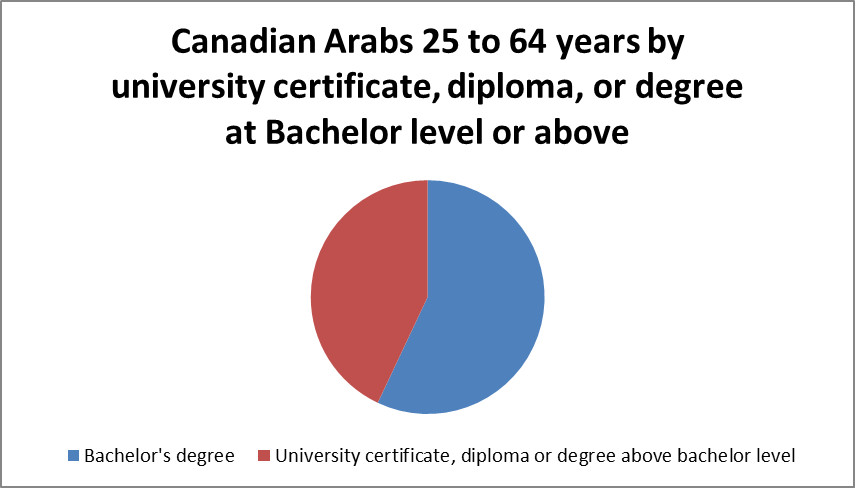
Figure 5
When it comes to the highest levels of academic achievement, Canadian Arabs are likely to hold degrees and certifications above the bachelor level 43% of the time. This rate is higher than the Canadian average of 36%, emphasizing the importance of higher levels of education within the Canadian Arab community.
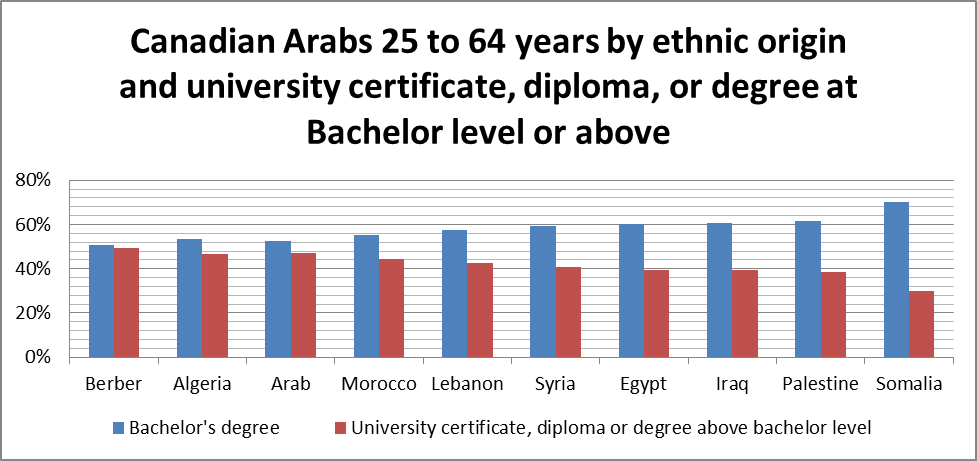
Figure 6
The trend within subgroups reveals that Berbers, Algerians, and Moroccans hold the highest percentages of post-bachelor education within the Arab community, whereas Iraqis, Palestinians, and Somalis have the lowest rates of university education beyond a bachelor’s level.
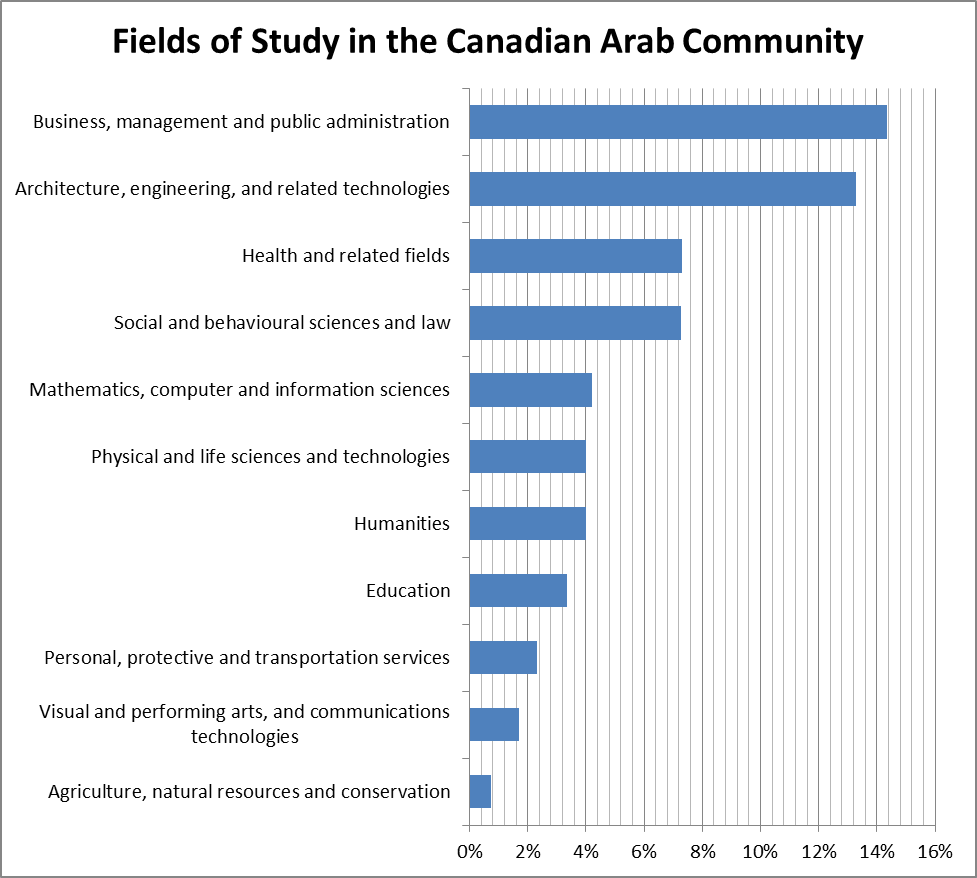
Figure 7
The field of study most popular within the Canadian Arab community is “business, management, and public administration” (14% of the population have pursued education in this field), followed by “architecture, engineering, and related technologies” (13% of the population), and “health and related fields” (11%). On the other hand, fields such as “agriculture, natural resources and conservation” (1% of the population) and “personal, protective and transportation services” (2%) show the lowest rates of participation among Canadian Arabs.
Employment in the Canadian Arab Community
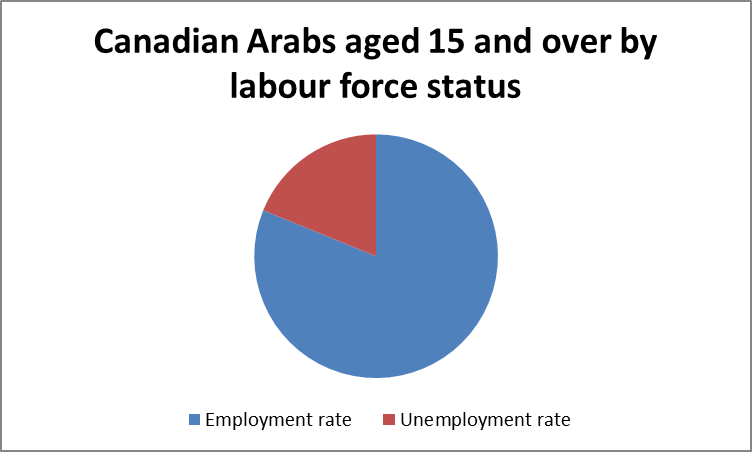
Figure 8
Whilst employment rates in the Canadian Arab community and the Canadian population are fairly comparable, at 60% and 56%, respectively, unemployment in the Canadian Arab community is significantly higher than that of the Canadian population, coming in at 13% in comparison to the national rate of 8%.
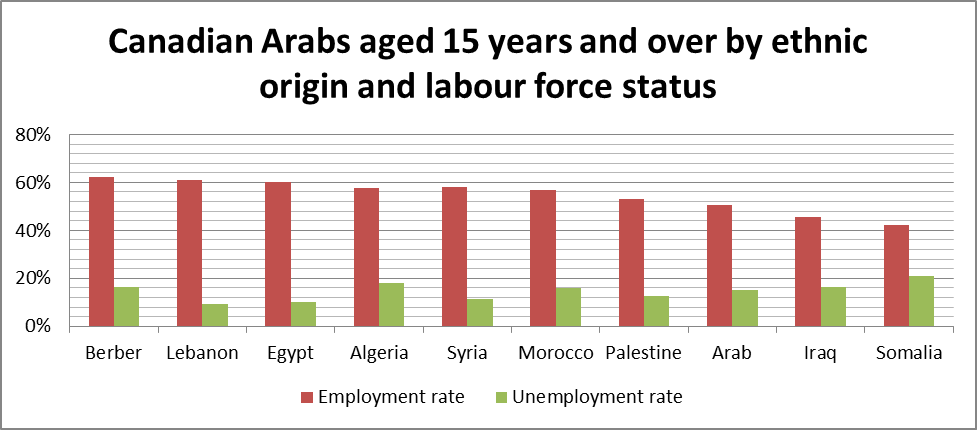
Figure 9
The distribution of the Canadian Arab labour force reveals that not all Canadian Arabs are equally competitive in the labour market. Whilst the Berber, Lebanese, Egyptian and Syrian communities thrive with the highest rates of employment and the lowest rates of unemployment, difficulties faced by the Iraqi and Somali communities in achieving similar success are evident, as they present the lowest rates of employment and the highest rates of unemployment within the community.
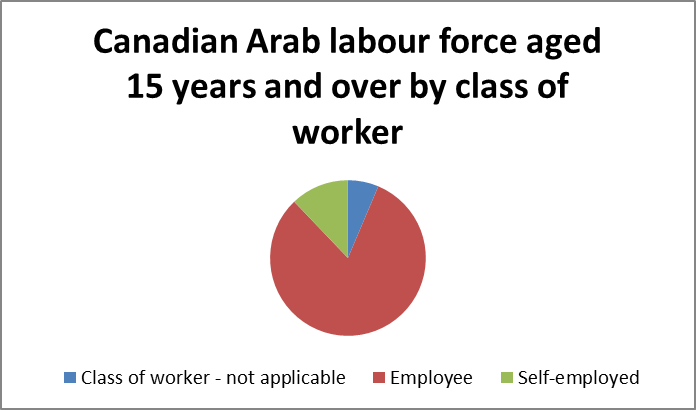
Figure 10
When it comes to the type of employment within the Canadian labour force, Canadian Arabs are far more likely to find employment within organizations run by others than to establish their own businesses, with 86% of the population being employed by others in comparison to 7% who choose to be self-employed.
Table 3
|
Class of Worker |
||
|
Canadian Population |
Canadian Arab Community |
|
|
Class of worker – not applicable[iii] |
2% |
6% |
|
Employee |
87% |
86% |
|
11% |
7% |
|
The Canadian Arab community is just as likely as the general Canadian population to seek employment in organizations run by others, yet they are less likely than their Canadian counterparts to establish their own enterprises.
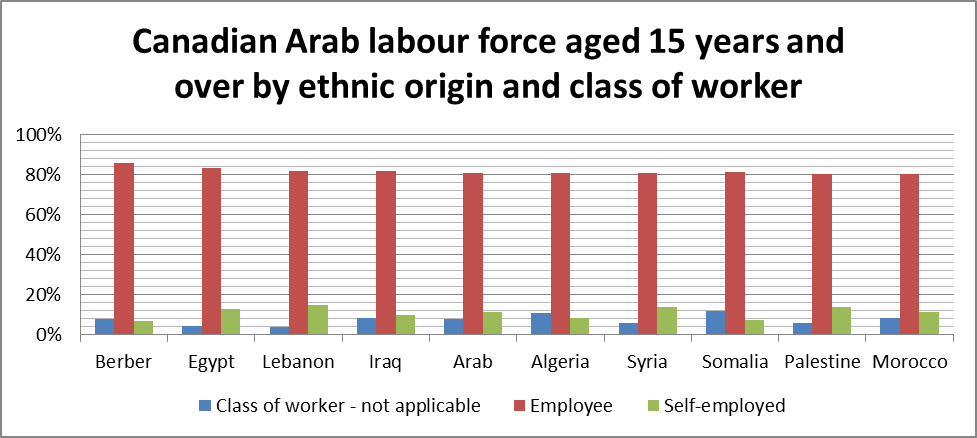
Figure 11
Within the Canadian Arab community sub-groups, the rate of self-employment is highest among the Lebanese (15%), followed by Palestinian and Syrian (each at 14%). On the other hand, Algerians (8% self-employed) and Somalis (7%) are the least likely sub-groups within the Canadian Arab community to pursue self-employment.
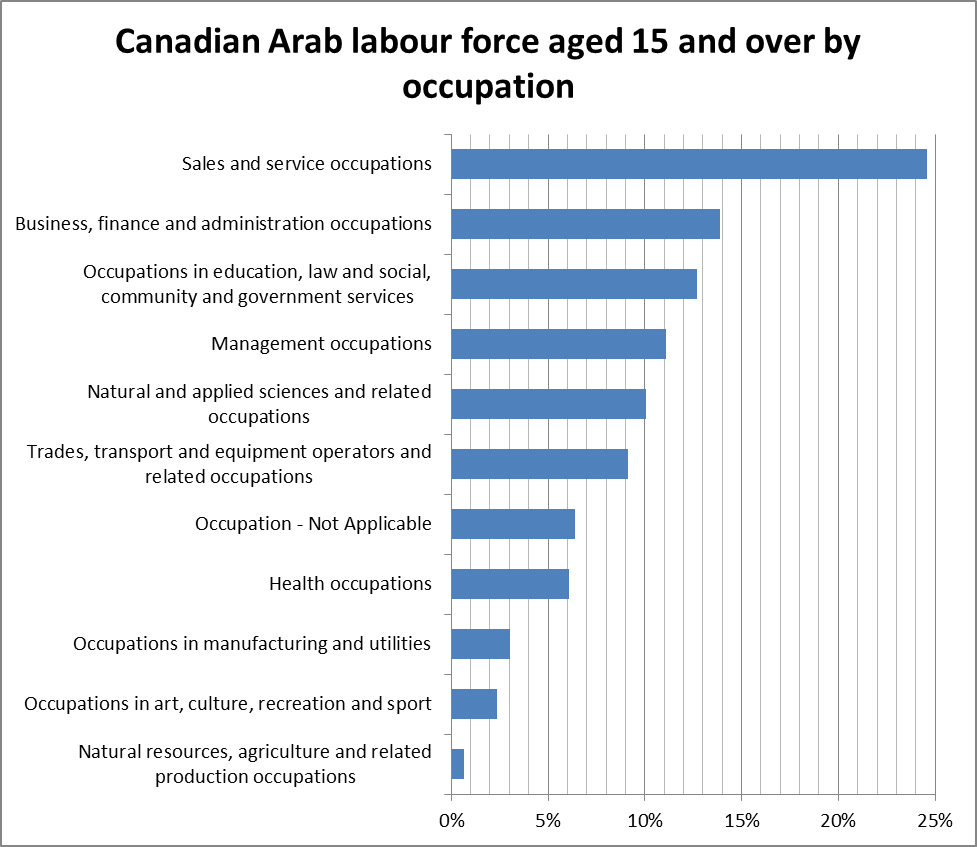
Figure 12
The trends in the fields of occupation prevalent in the Canadian Arab community mirror their choices in fields of education to a large extent – with the vast majority of Canadian Arabs working in the sales and service occupations (25%), business, finance, and administration occupations (14%), and management occupations (11%). Therefore, Canadian Arabs are largely employed in white collar positions, and to a large extent in the fields of business and commerce.
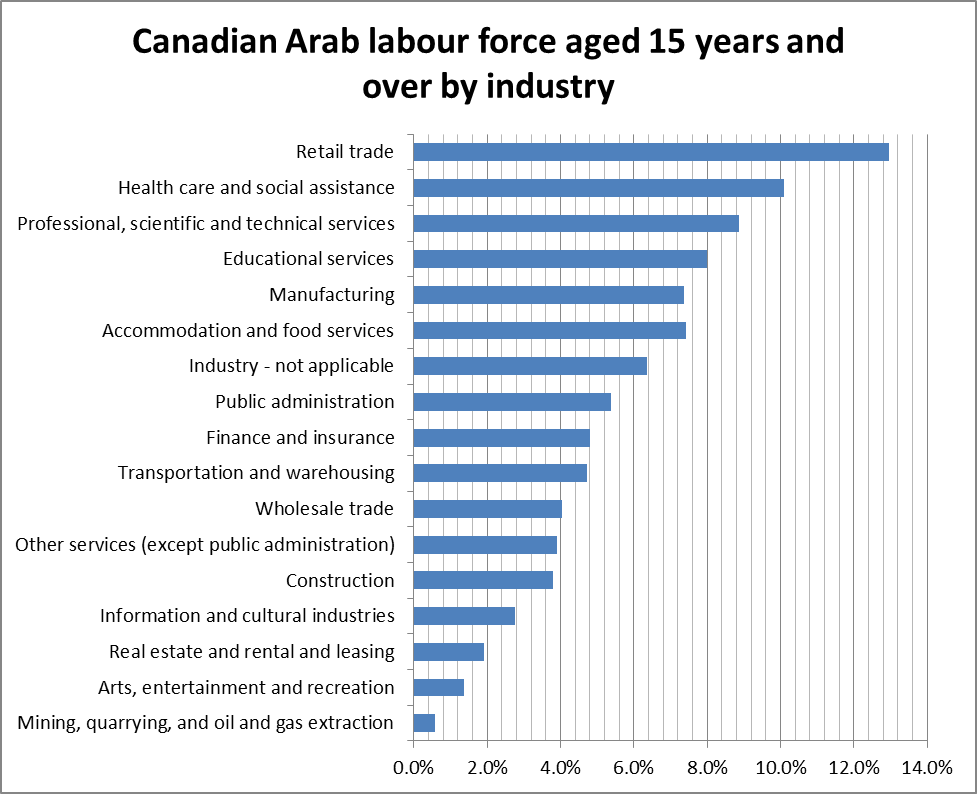
Figure 13
Finally, the most popular industries employing Canadian Arabs fall within certain service sectors – retail trade, accommodation and food services, finance and insurance, information and cultural industries, real estate and rental and leasing, and arts, entertainment and recreation – which, when combined, account for 31% of the employment of Canadian Arabs. In addition, the medical and professional sciences industries – comprised of healthcare and social assistance as well as professional, scientific, and technical services –account for 20% of the population’s employment.
In summary, Canadian Arabs can be classified as a highly educated community, comprised of high levels of qualification and academic achievement, as well as a community that is strong in its presence in white-collar and high-skill industries that are both highly competitive and lucrative. Yet, the community faces an unemployment rate that is five percentage points higher than the national average.